How to Rank on Google's First Page in 2026
INTRODUCTION
Over 90% of users never scroll past Google’s first page — meaning if your site isn’t there, you’re invisible. The good news? Ranking on Google’s first page in 2026 is achievable for beginners when you follow the right process. This guide walks you through every step, from keyword research to tracking results.
How to Rank on Google's First Page in 2026
Google’s first page displays the top 10 organic results. Landing here – especially in the top 3 positions – captures the majority of clicks for that keyword. Google ranks pages using signals like content relevance, site authority, page speed, and user experience. In 2026, the algorithm is more intent-focused than ever, but core SEO principles remain the same.
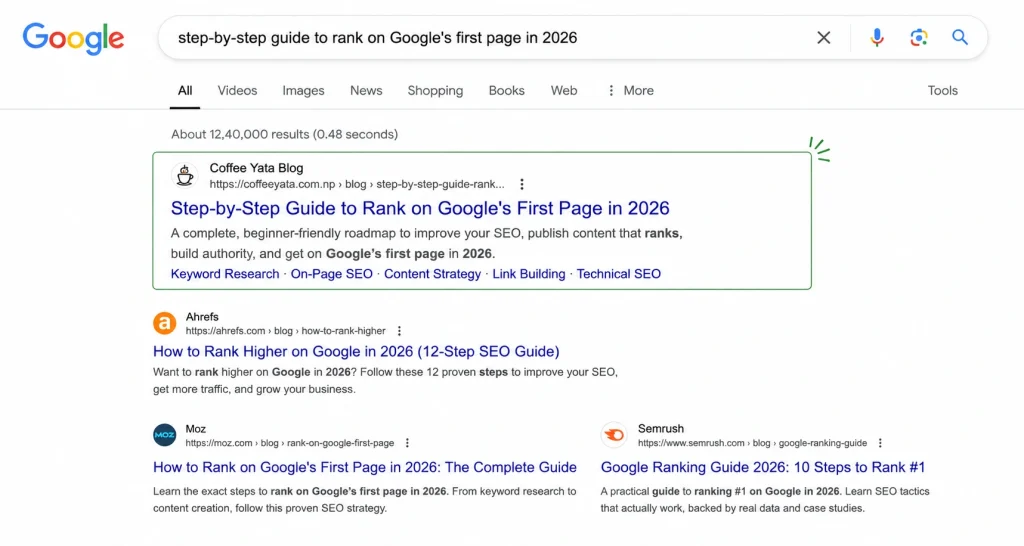
Google's Key Ranking Factors in 2026
- E-E-A-T — Experience, Expertise, Authoritativeness, Trustworthiness. Google rewards credible, first-hand content.
- Content Quality — Comprehensive, well-structured content that fully answers the user's search intent.
- Backlinks — Links from reputable sites signal authority and trustworthiness to Google.
- Core Web Vitals — Page speed (LCP), interactivity (INP), and visual stability (CLS) directly impact rankings.
- On-Page SEO — Strategic keyword placement in titles, headings, meta descriptions, and body content.
- Mobile-First — Google indexes the mobile version of your site; it must work flawlessly on phones.
Step-by-Step Guide to Rank on Google's First Page
Step 1 - Do Keyword Research
Target keywords with enough search volume but manageable competition for your site’s current authority.
- Free tools: Google Keyword Planner, Ubersuggest, AnswerThePublic
- Paid tools: Ahrefs, SEMrush, Moz
- Focus on long-tail keywords (3–5 words) – lower competition, faster to rank
- Identify search intent: informational, navigational, or transactional
Step 2 - Create Intent-Matched, High-Quality Content
Google rewards content that best satisfies what the user is actually looking for. Match your format to the intent – if users want a guide, write a guide.
- Cover the topic comprehensively — aim to be more helpful than the current top results.
- Use your focus keyword naturally at 1–1.5% density (Rank Math tracks this).
- Structure with H1 > H2 > H3 headings to help Google understand your content hierarchy.
- Add internal links to related posts and external links to authoritative sources.
Step 3 - On-Page SEO Optimization
- Title Tag: Focus keyword near the start, under 65 characters
- Meta Description: 150-160 chars with focus keyword
- URL Slug: Short and keyword-rich (e.g., /how-to-rank-on-googles-first-page/)
- First 100 Words: Include the focus keyword early
- Image Alt Text: Describe images using the focus keyword where relevant
- Schema: Enable Article + FAQPage schema in Rank Math
Step 4 - Build Backlinks
- Guest blogging – contribute posts to niche-relevant sites with a link back.
- HARO (Help a Reporter Out) – earn editorial links from news and media sites.
- Broken link building – find dead links on other sites and pitch your content as a replacement.
- Internal linking – pass link equity from your existing high-traffic posts to newer ones
Step 5 - Optimize Page Speed & Core Web Vitals
- Use a lightweight WordPress theme: Astra, GeneratePress, or Kadence
- Install a caching plugin: WP Rocket, LiteSpeed Cache, or W3 Total Cache
- Compress images with ShortPixel or Smush before uploading
- Use Cloudflare CDN and enable lazy loading
- Target: LCP under 2.5s, CLS under 0.1, INP under 200ms
Step 6 - Track & Improve
SEO is ongoing. After publishing, monitor and refine regularly.
- Google Search Console – track rankings, impressions, CTR, and crawl errors.
- Google Analytics 4 — measure organic traffic and user behaviour.
- Update content every 6-12 months – refresh stats, examples, and outdated information.
Frequently Asked Questions (FAQ)
How long does it take to rank on Google's first page?
Typically 3-6 months for low-competition keywords, and up to 12 months for competitive ones. Targeting long-tail keywords with lower difficulty speeds up the process significantly.
: Can beginners rank without backlinks?
Yes – for low-competition, long-tail keywords. Strong on-page SEO and high-quality content can rank new pages without backlinks. For competitive keywords, backlinks are essential over time.
How many keywords should one post target?
One primary keyword plus 2–5 supporting secondary keywords. Keep density around 1-1.5%. Keyword stuffing harms rankings – Rank Math flags over-optimization.
What's the ideal word count for ranking on Google's first page?
For informational guides, aim for 2,000–3,000 words. Longer content tends to rank better because it covers topics more completely — but only add length that adds value.
Is Rank Math better than Yoast SEO?
Both are excellent. Rank Math provides more features in the free plan – multi-keyword optimization, schema builder, and built-in analytics – making it the popular choice for beginners in 2026.
Ready to Rank on Google's First Page?
You now have the full roadmap. Start with keyword research, publish your first optimized post, and track results in Google Search Console.
Want to go beyond SEO?
Learn how to drive targeted traffic with Google Ads and Meta Ads in our Performance Marketing Course Nepal.